Pages

Wednesday, April 21, 2010

Open Access and Publishing


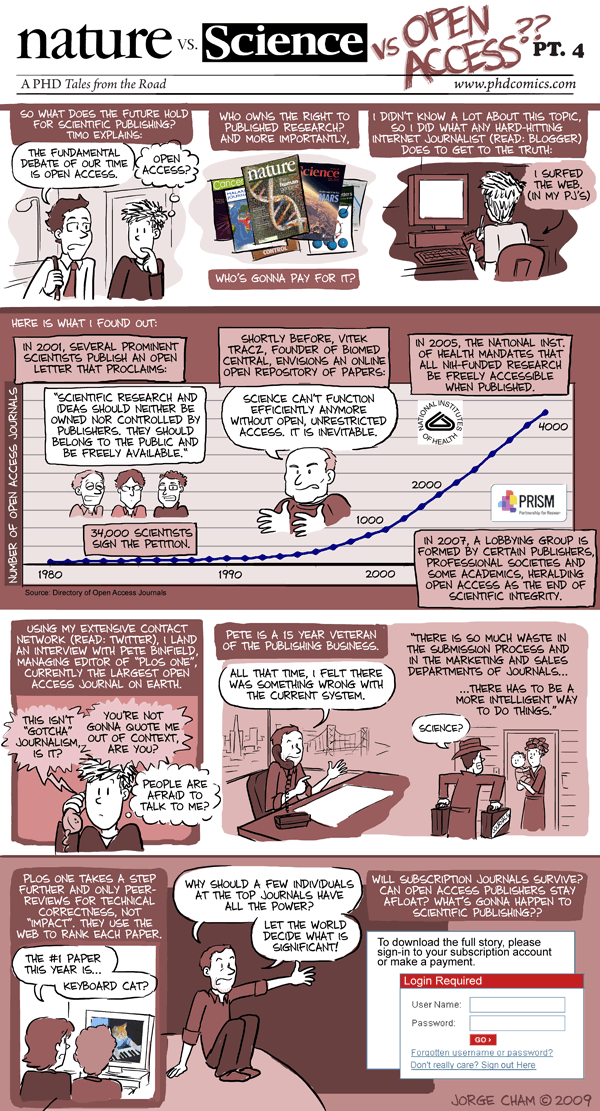
One of the interesting topics discussed in my Preparing Future Faculty class has been the change in ownership as well as the authenticity of published journals vs online "publishing". It is interesting to view authorship through the scope of scientific progress. The possibility is that there could be literally no cost to publishing science. This opens the door to all scientists and breaks down the barrier of formal education, but when that happens, fear walks in and proclaims that science itself will not be trustworthy.

It also raises an interesting question of where the funding for research comes from and where it will come from. This has been one of the motivating factors behind my blog posting of my experimental setup. So far my CFD work has been traditional "closed" science, while my experimental work has been "open" science. I am considering ways of making the CFD work more open, but my personal question becomes, "If I make posts about how to really do the work I am doing and someone learns it well enough to do it, what is left for me to do?"

Peace,

Landon

Friday, April 16, 2010

Whorls and Fleas

This morning, I was speaking with my friend who conducts himself in the scientific process within the Life Sciences building at VCU. Over breakfast we discussed the difference between Analytical, Empirical, and Numerical Analysis. These distinctions may not be something that are on your radar, but they play an important role in the drama/comedy of my life and work.

Please allow me to set the stage...

Analytical Sciences are formed out of Philosophic principals applied to societal needs. An interesting side note, Plato can be seen as a good example of the analytical scientist, but he was following in the footsteps of Socrates the "politician" (Good General Greek History). Plato created thought experiments, but he never tested them because of his belief that experimentation was never necessary. Similar to Einstein's thought experiments on quantum study because they were unable to do experimental work on that scale at the time (not by choice).

Similar to Plato stepping away from politics, Aristotle stepped away from unverified thought. Aristotle changed the way we see science by applying simple logic and keeping track of (empirical science). Statements are made by logically following physical observations and isolating the system you are observing to discover what might cause the change. This progressed for a while, but we'll fast forward a couple thousand years or so and settle on Galileo and the easy target of Sir Issac Newton to explore more of what we mean about the merging of empirical and analytical.

Mr. Issac's well known laws of motion (1687) are sentences that describe the motions of objects and relate Galileo's work on celestial bodies to objects we live in contact with. Every word is deliberate and has a precise meaning. These are analytical relationships, but the are confirmed with experimental success. Newton however, also offered "numerical" possibilities in his solution of problems which could not be solved "analytically".

Considering lastly the subject you may be least familiar with, Numerical Anaylsis. Leonard Euleris a good subject to discuss for the application of analytical and empirical thought to the pursuit of an answer, a result, a number. While this branch has been around for a very long time, it is the implementation of the personal computer that allows for a great number of calculations to be followed through quickly and reliably. Prior to the computer iterations would be computed by hand and could take months to complete. As an interesting anecdote, in 1910 Lewis Fry Richardson ran numerical analysis to predict the weather at 1 pm based on the weather at 7 am. Three months later, his results were incorrect, but his process was mostly correct and the amount of work it took to do by hand is astonishing. "He calculated himself that it would need 60,000 people involved in the calculations in order to have the prediction of tomorrow's weather before the weather actually arrived.(ref)"

The process of numerical analysis in terms of my research can be seen simply as using things that people like Euler came up with and Richardson used to simplify complex problems. These complicated problems are Differential equations, which simply means that things that we observe are changing with respect to the change in a quantity (or two, or three or more). These equations are "coupled" meaning that you have to solve them all at the same time. So numerical analysis is taking a small problem that is very complicated and translating it into a simple problem that is very large.

So what?

Ok, so the point is that there are many people who have undergone the tasks of science and I am studying in this line of scientists. I resonate with little bits of each biography and I am beginning to see why it is a good thing that I am studying as I am at VCU. I am forced now to learn to be comfortable with each side of discovery. My advisor excelled in analytical thought during his undergraduate and graduate education and has applied that to Numerical Analysis to become one of the top in his field. He has worked with Dr. Mike Oldham, who is similar and different in various areas of life. His passion for science is similar, but his passion is in the mechanics of the lab, not the numerics of the problem. He walked into the organized lab and just destroyed the cleanliness, but turned it into a real lab. He undid the assembling I had wondered about and guess and connected all the parts in a way that took up a small amount of space and will actually work. It is the kind of thing that comes with ~30 years experience, he's a good person to know.

Dr. Longest and Dr. Oldham both look at me like I'm doing something they are sure glad they don't have to. Both of them have great respect for the other's work, but are not comfortable doing it. Their goal for me is to be able to generate data from computer studies, validate it with experiments. This allows them to pontificate analytical relationships using these correlations. The interesting part for me is the application to the social and political. The application of my project to people and the impact it can have. But I am learning about the other parts because they are necessary to be well rounded.

Till Then, Poetry. - Landon
Big fleas have little fleas

Upon their backs to bite 'em,

And little fleas have lesser fleas

And so, ad infinitum.

-- Jonathan Swift

Big whorls have little whorls

That feed on their velocity,

And little whorls have lesser whorls

And so on to viscosity.

-- Lewis F. Richardson
Thursday, April 15, 2010

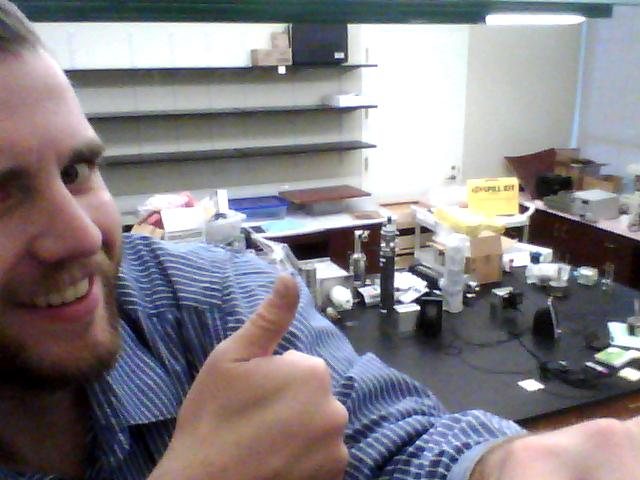
She may not look like much, but she's got it where it counts, kid.

Dr Oldham visited to round out the first week of empiricism. He walked in lab proud of the equipment and confident in the ability of the devices to produce useful data.

Many hours later he walked out of the lab leaving a parts list for materials needed to finish setting up the lab so we can begin to gather some data. The list comes from a range of suppliers. From the auto store, to McMaster-Carr we will be placing an order next week, and then I will be returning to numerical studies while we wait for the parts to arrive.

I may document some of the more interesting parts of the numerical work, but there is much less attention grabbing items on computer screens than in an experimental lab, so we'll just see how it goes.

Till again-

Landon

Wednesday, April 14, 2010

Day three, a visit from Ben Kenobi


With Ben Spence's help we have setup the lab and I am beginning to understand what some of the machines do in it. But this is all very important for us to have it like this because today we'll have a visitor. A wise sage, Dr. Mike Oldham, is coming to give us guidance in becoming experimentalists.


We intend to duplicate an experimental setup that he used in 1997. This will be to get us experience with the devices, but then we will branch out and insert our own devices into the experimental design.

Here's to a week on the empirical side of science.


Cheers,

Landon

Tuesday, April 13, 2010

Day 2 Engineering Experiment

From Ordinary Radical Engineering

With yesterday spent organizing, today is to be spent assembling something to resemble an experiment and help generate questions for the expert, Dr. Mike Oldham. He is coming on Wednesday to answer questions I have and see how we have things setup.

From Ordinary Radical Engineering

With that, I'm off!

Peace,

Landon

Monday, April 12, 2010

What does a PhD in Mechanical Engineering look like at VCU

I'm transitioning from the pursuit of my Bachelor of Science in Engineering to my new pursuit of a PhD in Mechanical Engineering at VCU. I've been writing about the class I have been taking that is preparing me for the teaching and administrative side of obtaining a PhD. This is but one side of a three sided program. In addition to teaching and fulfilling administrative tasks I will also be conducting research.

Without further ado, I will begin my documentation of the experimental side of my research. I work for Dr. P Worth Longest in Mechanical Engineering. For years Dr. Longest has been conducting research in aerosols science and particle deposition . Well, as I am starting my work with him and am going to be here for a while, Dr Longest would like to begin an experimental side of his research to validate previous correlations and create new ones for future works. The difference between computational and experimental sciences is gigantic, but our plan is for me to be able to understand both and create case studies that spring from physical reality and can be validated by systematic numerical analyses.

Before this I have to wash the countertops and the shelves and learn what all this equipment does. Similar to a cooking blog I am hoping to add updates and include pictures. I will try to remember to bring in my camera and take nicer pictures, but to begin I will just post the overall look of the lab.


Peace,

Landon

Monday, March 29, 2010

Net Gen- The Catering Gen


Net Gen learners are young and they've been raised on computers. Because they were raised inside of technology, they've broken many conceptions of how long and how difficult it is to learn a process. Generation X can take classes and work on keeping up to date with technology, but at some point they have settled into "what works." The Net Gen doesn't know what works, but they have access to everything that might work. Through this access the Net Gen is able to explore possibilities in a fresh way and use whatever software or device is most efficient for the task.

In a video game you being with no idea of how to play. You know how to use the controller, but level by level you learn new rules and button combinations that are useful in new and different situations presented to you in a logical way that leads you to quickly master a game. It all happens very quickly. Within two hours of playing a game you can become familiar with it and the more familiar you are with it, the more you enjoy it.

My problem is then with applying this video game mentality to real life. Net Gen students raised on technology can accelerate through many of the normal road blocks of education, and can learn the software needed to solve a problem more efficiently than those who are teaching. But the students need the problems laid out like a video game. Setting little goals along the way to gain minor skills until a point is reached where the student is comfortable with the game and can explore the harder levels.

I don't believe that there is true creativity within the gaming world. The creativity is in the side dishes served with the video game, but not contained within it. You can choose your name, you can choose who you play with, what you play and when you play. But once you are playing you are governed by a long list of rules that does not allow for much room to create. This is my problem with linking it to school, academia, research, or learning. Net Gen learners within the modern constraints are not allowed the room to explore and apply understanding to problems in their neighborhood, state, or country. Without this understanding of how actions change surroundings, everything becomes theoretical and one sided.

The net gen learners have always been catered to and are used to being told what to do, how to do it, why to do it, and when it needs to be done. What happens when the directives are not so clearly laid out?