Many of my friends are involved in this Academy. How encouraging it is to see this from VCU. Thank you Richmond Times Dispatch for writing this story as well!
Thursday, December 2, 2010
Church Hill tutoring sessions lift up neighborhood | Richmond Times-Dispatch


Thursday, September 16, 2010
Microlectures via Podcasting
From that article Dr. Reis from Stanford explains:
Podcasts do not need to contain the full information from a 60-to-90 minute lecture. San Juan College is experimenting with "microlectures," a traditional lecture in which key concepts and themes are condensed down to a one to three minute segment (Shieh, 2009, p. 1). Some faculty find that a three-to-five minute audio clip is an optimum podcast length, similar to the length of a song students listen to on the radio (Walsh, 2004). Because microlectures are limited in the amount of content they can convey, students are required to complete their learning with additional readings and assignments. Pedagogical limitations include situations where a prolonged discussion or explanation is necessary, such as when solving mathematical problems, extending English literature discussions, and explaining complicated processes.
But how intriguing are the possibilities that result from all of the creative uses of podcasting as a learning tool? It reminds me of a section of Grad 602: Teaching and Technology in Higher Education, which focused on learning through generating content. If we can help students to create content, not only will they be learning as they do it, but they will be writing the "textbooks" that the students who follow after them will use. By bringing the textbook authorship back to the people who are learning, you will produce a more relevant and discernible learning aid.
Wednesday, August 25, 2010
Landon's Lab Lets Loose
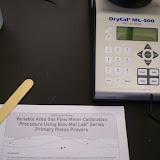
So experimental work has been slow moving, but we have fixed our heater problem, found and fixed the AC adapter for our flowmeter, ordered additional rotameters, determined the correct dilution for our aerosol, used a fluorescent microscope to view our geometry and properly cut our tubing to equal lengths for our Lung geometry. Enjoy. Dr. Oldham is coming again tomorrow and I hope to have a filter paper with particles on it to show him! Early day tomorrow!
-Landon
Monday, August 9, 2010
Valedictorian on Education
Swiftkick reposted Erica Goldson's graduation speech as Valedictorian of her high school class.
Her energy is refreshing and she is able to verbalize glaring problems (not new problems) with our system of education.
Thursday, July 15, 2010
Progress!
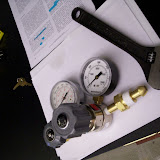
A new post, A new post. Yes, progress to the process. Documented above. I will make some more posts about the work that will happen in the next week:
-Presentation of progress to Dean Jamison on Wednesday
-Generation of the first aerosol, hopefully before then!
More to come!
Wednesday, April 21, 2010
Open Access and Publishing
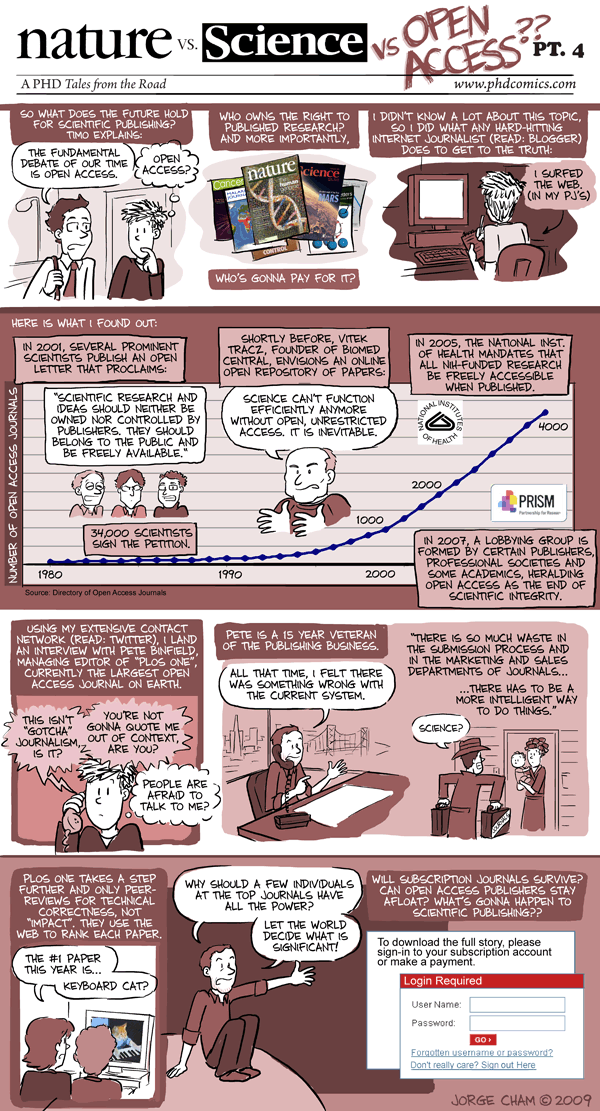
It also raises an interesting question of where the funding for research comes from and where it will come from. This has been one of the motivating factors behind my blog posting of my experimental setup. So far my CFD work has been traditional "closed" science, while my experimental work has been "open" science. I am considering ways of making the CFD work more open, but my personal question becomes, "If I make posts about how to really do the work I am doing and someone learns it well enough to do it, what is left for me to do?"
Peace,
Landon
Friday, April 16, 2010
Whorls and Fleas
This morning, I was speaking with my friend who conducts himself in the scientific process within the Life Sciences building at VCU. Over breakfast we discussed the difference between Analytical, Empirical, and Numerical Analysis. These distinctions may not be something that are on your radar, but they play an important role in the drama/comedy of my life and work.
Please allow me to set the stage...
Analytical Sciences are formed out of Philosophic principals applied to societal needs. An interesting side note, Plato can be seen as a good example of the analytical scientist, but he was following in the footsteps of Socrates the "politician" (Good General Greek History). Plato created thought experiments, but he never tested them because of his belief that experimentation was never necessary. Similar to Einstein's thought experiments on quantum study because they were unable to do experimental work on that scale at the time (not by choice).
Similar to Plato stepping away from politics, Aristotle stepped away from unverified thought. Aristotle changed the way we see science by applying simple logic and keeping track of (empirical science). Statements are made by logically following physical observations and isolating the system you are observing to discover what might cause the change. This progressed for a while, but we'll fast forward a couple thousand years or so and settle on Galileo and the easy target of Sir Issac Newton to explore more of what we mean about the merging of empirical and analytical.
Mr. Issac's well known laws of motion (1687) are sentences that describe the motions of objects and relate Galileo's work on celestial bodies to objects we live in contact with. Every word is deliberate and has a precise meaning. These are analytical relationships, but the are confirmed with experimental success. Newton however, also offered "numerical" possibilities in his solution of problems which could not be solved "analytically".
Considering lastly the subject you may be least familiar with, Numerical Anaylsis. Leonard Euleris a good subject to discuss for the application of analytical and empirical thought to the pursuit of an answer, a result, a number. While this branch has been around for a very long time, it is the implementation of the personal computer that allows for a great number of calculations to be followed through quickly and reliably. Prior to the computer iterations would be computed by hand and could take months to complete. As an interesting anecdote, in 1910 Lewis Fry Richardson ran numerical analysis to predict the weather at 1 pm based on the weather at 7 am. Three months later, his results were incorrect, but his process was mostly correct and the amount of work it took to do by hand is astonishing. "He calculated himself that it would need 60,000 people involved in the calculations in order to have the prediction of tomorrow's weather before the weather actually arrived.(ref)"
The process of numerical analysis in terms of my research can be seen simply as using things that people like Euler came up with and Richardson used to simplify complex problems. These complicated problems are Differential equations, which simply means that things that we observe are changing with respect to the change in a quantity (or two, or three or more). These equations are "coupled" meaning that you have to solve them all at the same time. So numerical analysis is taking a small problem that is very complicated and translating it into a simple problem that is very large.
So what?
Ok, so the point is that there are many people who have undergone the tasks of science and I am studying in this line of scientists. I resonate with little bits of each biography and I am beginning to see why it is a good thing that I am studying as I am at VCU. I am forced now to learn to be comfortable with each side of discovery. My advisor excelled in analytical thought during his undergraduate and graduate education and has applied that to Numerical Analysis to become one of the top in his field. He has worked with Dr. Mike Oldham, who is similar and different in various areas of life. His passion for science is similar, but his passion is in the mechanics of the lab, not the numerics of the problem. He walked into the organized lab and just destroyed the cleanliness, but turned it into a real lab. He undid the assembling I had wondered about and guess and connected all the parts in a way that took up a small amount of space and will actually work. It is the kind of thing that comes with ~30 years experience, he's a good person to know.
Dr. Longest and Dr. Oldham both look at me like I'm doing something they are sure glad they don't have to. Both of them have great respect for the other's work, but are not comfortable doing it. Their goal for me is to be able to generate data from computer studies, validate it with experiments. This allows them to pontificate analytical relationships using these correlations. The interesting part for me is the application to the social and political. The application of my project to people and the impact it can have. But I am learning about the other parts because they are necessary to be well rounded.
Till Then, Poetry. - Landon
Big fleas have little fleasUpon their backs to bite 'em,
And little fleas have lesser fleas
And so, ad infinitum.
-- Jonathan Swift
Big whorls have little whorlsThat feed on their velocity,
And little whorls have lesser whorls
And so on to viscosity.
-- Lewis F. Richardson
Subscribe to:
Posts (Atom)